
December 2025 Edition — COA BulletinIndustry Advancements
Sharing white papers and sponsored content from industry partners. Gain a front-row view into the technologies and solutions shaping the future of the profession.
White papers have been sponsored by various organizations and are published in the COA Bulletin. While the COA facilitates the dissemination of these papers, it does not endorse or take responsibility for the accuracy, completeness, or reliability of the content. All papers are subject to review by the Editorial Board, however the views, findings, and conclusions expressed remain those of the respective authors or sponsoring entities and do not necessarily reflect the official policy or position of the COA and its affiliate organizations or the Editorial Board. The COA assumes no liability for any decisions made based on the information presented and encourages readers to critically evaluate the content and consult additional sources before taking action.
Orthopaedic Surgery VTE Thromboprophylaxis: Guidelines Summary

Marc Carrier, MD, MSc, FRCPC
The Ottawa Hospital, Medicine
Ottawa, ON
Lena Chamberlain, RN, BScN, CPN(C), CGN(C)
William Osler Health System, Etobicoke ON
Javad Parvizi, MD, FRCS
Orthopaedic Surgeon
Acibadem University, Istanbul, Turkey
Abstract
Venous thromboembolism (VTE) is a significant and preventable complication following orthopaedic surgery, with incidences reaching up to 60% without thromboprophylaxis. This comprehensive document synthesizes recommendations from leading international guidelines to support healthcare professionals in implementing evidence-based thromboprophylaxis strategies.
All patients undergoing orthopaedic surgery should undergo individualized risk assessment for both VTE and bleeding preoperatively. High-risk procedures include hip and knee arthroplasty, spine surgery, and major trauma. Key patient-related VTE risk factors include advanced age, immobility, obesity, cancer, and history of VTE. Similarly, bleeding risks should be evaluated, as complications may affect outcomes and require thromboprophylaxis strategy modification.
Pharmacologic thromboprophylaxis, including low molecular weight heparin, direct oral anticoagulants, and acetylsalicylic acid, remains the cornerstone of VTE prevention, with duration and agent tailored to procedure type and patient characteristics. Mechanical thromboprophylaxis, including intermittent pneumatic compression and graduated compression stockings, are essential adjuncts, particularly in patients with high bleeding risk or contraindications to anticoagulation. Combined pharmacologic and mechanical approaches also offer superior protection.
This Orthopaedic Surgery VTE Thromboprophylaxis Guidelines Summary supports healthcare providers in optimizing thromboprophylaxis strategies and improving surgical outcomes. It also promotes a multidisciplinary, patient-centered approach involving physicians, nurses, pharmacists, and allied health professionals.
Introduction
Venous thromboembolism (VTE) after orthopaedic surgery, presenting as deep vein thrombosis (DVT) and/or pulmonary embolism (PE), is a potentially preventable cause of morbidity and mortality1,2. The incidence of VTE after orthopaedic surgery without thromboprophylaxis can be as high as 60%1 .
Multiple guidelines exist addressing surgical thromboprophylaxis. While none of these guidelines is universally accepted and each approaches the subject in different ways, each offers useful guidance in prevention of VTE in patients undergoing orthopaedic procedures. This document provides a synopsis of what we believe are the most important elements to consider from the most commonly used guidelines on thromboprophylaxis for orthopaedic surgery (Table 1), citing the guidelines published most recently first.
The prevention of VTE is a serious concern and falls under purview of all healthcare providers involved in the patient’s health journey, including physicians, nursing, pharmacy, respiratory, occupational, and rehabilitation therapists. We encourage a collaborative approach with clear and consistent communication between providers to reduce/prevent VTE and potentially dire consequences
Table 1: Guidelines included in this summary
| Guideline | Short form reference |
| European guidelines on peri-operative venous thromboembolism prophylaxis. Chapter 5: Mechanical prophylaxis (2024)3 | European guidelines 2024 |
| Prevention and management of venous thromboembolism. International Consensus Statement 20244 | International Consensus 2024 |
| The ORNAC standards, guidelines, and position statements for perioperative registered nurses (2023)5 | ORNAC 2023 |
| Guideline for prevention of venous thromboembolism, AORN eGuidelines+6 | AORN 2023 |
| Recommendations from the ICM-VTE: General (2022)7 | ICM-VTE General 2022 |
| Recommendations from the ICM-VTE: Hip & Knee (2022)8 | ICM-VTE: Hip & Knee 2022 |
| Recommendations from ICM-VTE Trauma (2022)9 | ICM-VTE: Trauma 2022 |
| American Society of Hematology 2019 guidelines for management of venous thromboembolism: prevention in surgical patients2 | ASH 2019 |
| Venous thromboembolism in over 16s: reducing the risk of hospital-acquired DVT or pulmonary embolism (NICE 2019)10 | NICE 2019 |
| AORN, Association of periOperative Registered Nurses; ICM, International Consensus Meeting; NICE, National Institute for Health and Care Excellence; ORNAC, Operating Room Nurses Association of Canada; VTE, venous thromboembolism | |
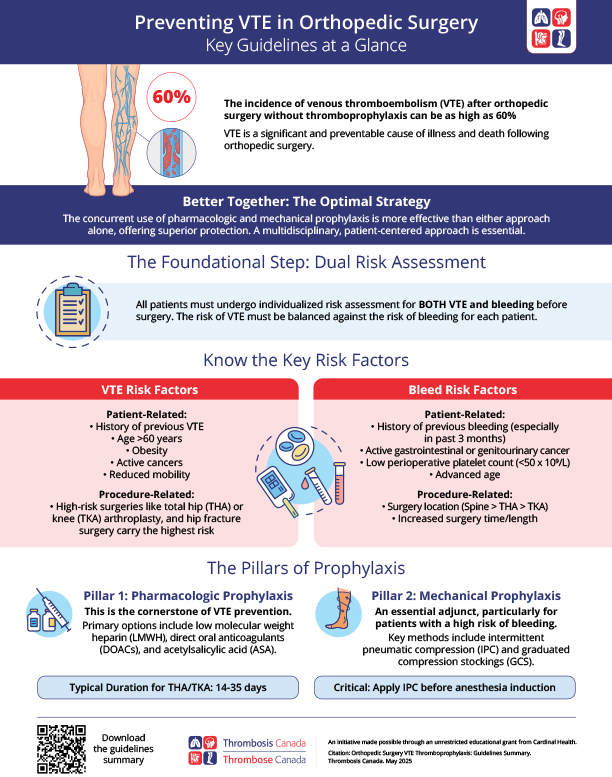
Click to download the full resolution infographic in PDF format
Characterization of the Asymmetric Bone Envelope of the Proximal Humeral Metaphysis for Stemless Shoulder Implants

Christine Mueri
Zimmer Biomet, Winterthur, Switzerland
Kyle Snethen
Zimmer Biomet, Warsaw, IN, USA
Raymond Parisi
Zimmer Biomet, Warsaw, IN, USA
Yang Son
Zimmer Biomet, Warsaw, IN, USA
Thomas Duquin
Dept of Orthopaedic Surgery, SUNY Buffalo, Buffalo, NY, USA
Study Completed July, 2024†
Introduction
Stemless humeral implants in anatomic total shoulder arthroplasty (TSA) are increasingly favored for preserving bone stock, relying on the bony structures of the proximal humeral metaphysis for mechanical stability. In many current stemless shoulder systems, the sizing of the implant is performed purely based on the dimension of the humeral head resection, whereas the humeral head resection may be performed following the anatomic articular margin or using fixed angle resection with predefined inclination and retroversion angles. An inadequate sizing or placement of a stemless humeral implant may lead to cortical impingement or periprosthetic fractures1. For the intra-operative sizing and/or stemless implant design, it is therefore imperative to understand the morphology and bone envelope of the humeral metaphysis and as it relates to different humeral head resections. Several studies2-5 have previously highlighted the large variability in the humeral morphology in terms of humeral head diameter, head offset, or neck inclination and retroversion angles. Reeves et al.5 characterized the bone envelope of the humeral metaphysis with respect to the native neck resection using fitted circles without considering the variability of the resection angles or the highly asymmetric morphology of the proximal humerus. This study aimed to develop a statistical model that characterizes the bony envelope (“safe zone”) for implant placement/design to reduce the risk of cortical impingement, accounting for common surgical variations in humeral head resection.
† Mueri, C., Snethen, K., Parisi, R., Son, Y., Duquin, T. Characterization of the Asymmetric Bone Envelope of the Proximal Humeral Metaphysis for Stemless Shoulder Implants. ORS Orthopaedic Research Society 2025 Annual Meeting, Paper No. 1175; 2025 Feb 7-11; Phoenix, Arizona