December 2025 Edition — COA BulletinResearch Innovations
Featuring subspecialty breakthroughs, notable papers, and research advancements. Discover the groundbreaking studies and innovations that are redefining musculoskeletal care.
Failure Analysis of Retrieved Orthopaedic Implants: Insights Learned from Transdisciplinary Collaborations
A Summary of the CORS Workshop held at the ICORS Congress 2025
 Isabelle Catelas, Ph.D., P.Eng., FIOR
Program Chair, Canadian Orthopaedic Research Society (CORS)
Ottawa, ON
Yolanda Hedberg, Ph.D.
London, ON
Emil H. Schemitsch, MD, FRCSC, FCAHS, FIOTA, FIOR
London, ON
 A workshop organized by the Canadian Orthopaedic Research Society (CORS), with support from the COA, was held during the recent International Combined Orthopaedic Research Societies (ICORS) Congress (October 8–11, in Adelaide, South Australia). As part of the COA/CORS commitment to advancing surgical care innovation, this workshop, titled “Failure analysis of retrieved orthopaedic implants: insights learned from transdisciplinary collaborations” examined how failure analyses of retrieved orthopaedic implants, and a better understanding of the pathomechanisms underlying the biological response to implant wear and corrosion, can improve patient outcomes.
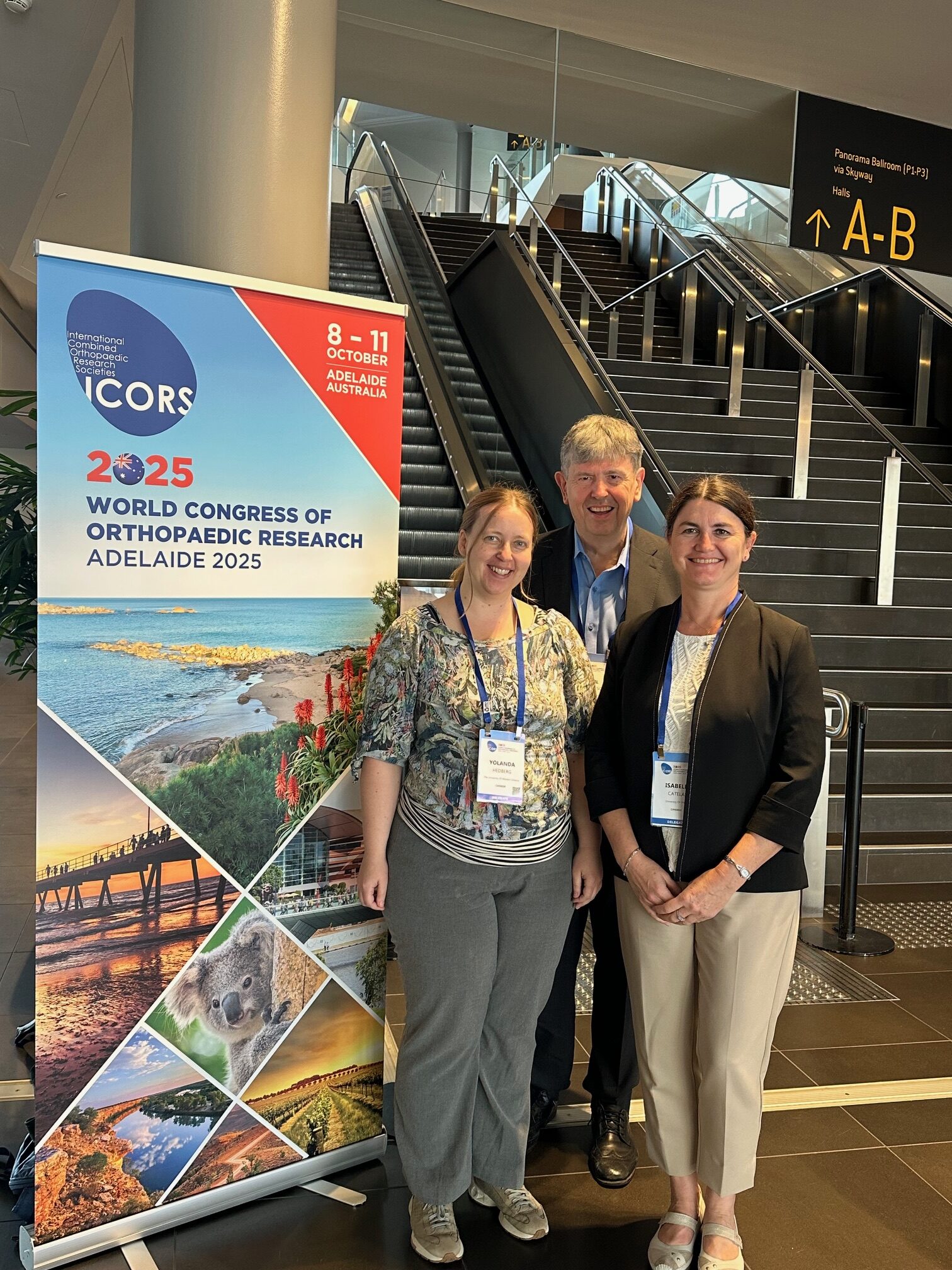
CORS Workshop leaders, Drs. Hedberg, Schemitsch and Catelas at the ICORS Congress 2025 in Adelaide
Over 137,000 joint replacement surgeries are performed annually in Canada, and a new joint is generally expected to relieve pain, restore mobility, and improve patient’s quality of life. Unfortunately, each year, approximately 8,000 to 10,000 of these procedures are unsuccessful and require riskier, more costly revision surgeries. The leading causes of failures – infection, aseptic loosening, instability, and periprosthetic fractures – can all be influenced by wear and corrosion processes. Many of these issues are due to an incomplete understanding of the mechanisms underlying implant failure. Current pre-operative screening protocols do not reliably predict which patients are most likely to experience complications, and considerable variability exists in implant selection and surgical techniques across the country. Although a cross-Canada network tracks some orthopaedic surgery data, no centralized database of failed implants currently exists. This workshop brought together a transdisciplinary team of leading scientists and clinicians with combined expertise in corrosion, imaging, biology, and surgery, all working towards the shared goal of reducing the burden of orthopaedic implant failures. The discussions underscored that this challenge cannot be properly addressed through traditional “siloed” approaches. Instead, transdisciplinary collaborations, supported by a centralized, cross-Canada database of implant failures, are essential to advance the field. Such a database would improve patient selection, refine surgical techniques, and advance the development of improved implant design, ultimately reducing revision rates and associated costs. Access to larger cohorts with longer follow-up would also enable a more comprehensive understanding of implant failure mechanisms and facilitate earlier detection of at-risk devices that may require closer monitoring.
 The workshop was organized by Dr. Isabelle Catelas, CORS Program Chair, and the speakers included:
- Isabelle Catelas (University of Ottawa), who discussed the underlying pathomechanisms of adverse local tissue reactions – including pseudotumors and hypersensitivity – to wear and corrosion products from orthopaedic implants. Dr. Catelas also reviewed current diagnostic approaches for these reactions and highlighted the development of new tools aimed at better identifying patients at risk of developing such reactions that can lead to implant failure.
- Yolanda Hedberg (University of Western Ontario), who highlighted what a detailed analysis of corrosion and wear mechanisms can tell about the failure mechanism of an orthopaedic implant, and presented insights from Western University’s Implant Retrieval Lab.
- Emil Schemitsch (Western University and London Health Sciences Centre) who demonstrated how a transdisciplinary approach – particularly the standardized analysis of failed implants across the country – is essential to ensuring equitable healthcare. Dr. Schemitsch further emphasized that such an approach would enable multifactor analyses to improve implant design and support well-controlled clinical research, which is currently lacking.
The workshop was well-attended, with over 60 participants, and generated extensive discussions on a range of topics, including differences between well-functioning and failed implants; best practices for cleaning retrieved implants, standardizing retrieval protocols, and storing retrieved implants to analyze their failure mechanism; and examples of cases illustrating specific failure mechanisms. The workshop also highlighted the importance of studying newer technologies and implant designs that are becoming more prevalent, such as uncemented knees. Participants emphasized the need to expand implant retrieval approaches to better investigate issues such as infection and metal hypersensitivity. These expanded approaches should be grounded in transdisciplinary collaboration drawing on expertise from imaging science, surface science and metallurgy, bioengineering, cell and molecular biology, genomics, microbiology and biofilms, the microbiome, immunology, and clinical trials.
Overall, this well-attended workshop highlighted the world-class research on implant failure mechanisms being conducted in Canada and elevated the visibility of COA/CORS internationally.
Taking Care of Our Own: Investing in Orthopaedic Research and the Future of Canadian Innovation
 Todd Charlebois
CEO, Canadian Orthopaedic Foundation
Almost five years have passed since I had the privilege of assuming the role of CEO of the Canadian Orthopaedic Foundation (COF). As we near the end of 2025, I am grateful to the COA for the opportunity to share some thoughts with you about the need to take care of our own.

At the 2025 Annual Meeting, COF CEO Todd Charlebois and President Dr. Bheeshma Ravi recognized industry leaders from Zimmer Biomet for supporting orthopaedic innovation and research in Canada.
2025 has been a wake-up call for Canadians. The stark challenge is for us to accept accountability for our present and future by taking care of ourselves, first. The Foundation is very representative of that concept. As Canada’s only national charity dedicated to orthopaedics, we are uniquely positioned as an engine to advance orthopaedics on a national scale. The donated funds that we invest in research, in Canadian researchers, have and will continue to yield benefits for Canadians and for people across the globe. Did you know that Canada’s collaborative approach to research is cited as our unique strength, as is the willingness of our population to participate in research projects?

At the 2025 Annual Meeting, COF CEO Todd Charlebois and President Dr. Bheeshma Ravi recognized industry leaders from Johnson & Johnson MedTech for supporting orthopaedic innovation and research in Canada.
I have been told many times that”Canadians punch above their weight” on the global research stage. Our unique approach is admired and recognized for yielding world class discoveries that shape MSK care. We just need to do more of it. Much more.
One of our industry leaders pointed out to me that the “wild west” of AI and robotics represent a unique opportunity for Canada. He raised the potential of the Foundation being a central hub for funding of research into AI and robotics with the results being shared among participating partners as a uniquely Canadian model. We have the talent and the culture required to drive discovery in orthopaedics like no other country can.
I am truly inspired by the generosity of individual and industry donors. I get to speak with donors from across the country who donate $25 monthly on behalf of a loved-one whose quality of life was restored by one of you, from researchers providing updates on their progress of discovery and from partners seeking to invest in Canadian researchers.
“Let’s take care of our own” is a reminder that we, now more than ever, need to invest more in ourselves so that we are less dependent, but more importantly, encourage and support our researchers as they redefine the horizons of discovery in orthopaedic care, at home and around the world.
What are your thoughts? Reach me directly at todd@canorth.org. To learn more about the Foundation and our research funding opportunities, visit movepainfree.org.